Enjoying Spring-in January
 9:50 AM |
  Posted by
Gabby Faye |
Posted by
Gabby Faye |


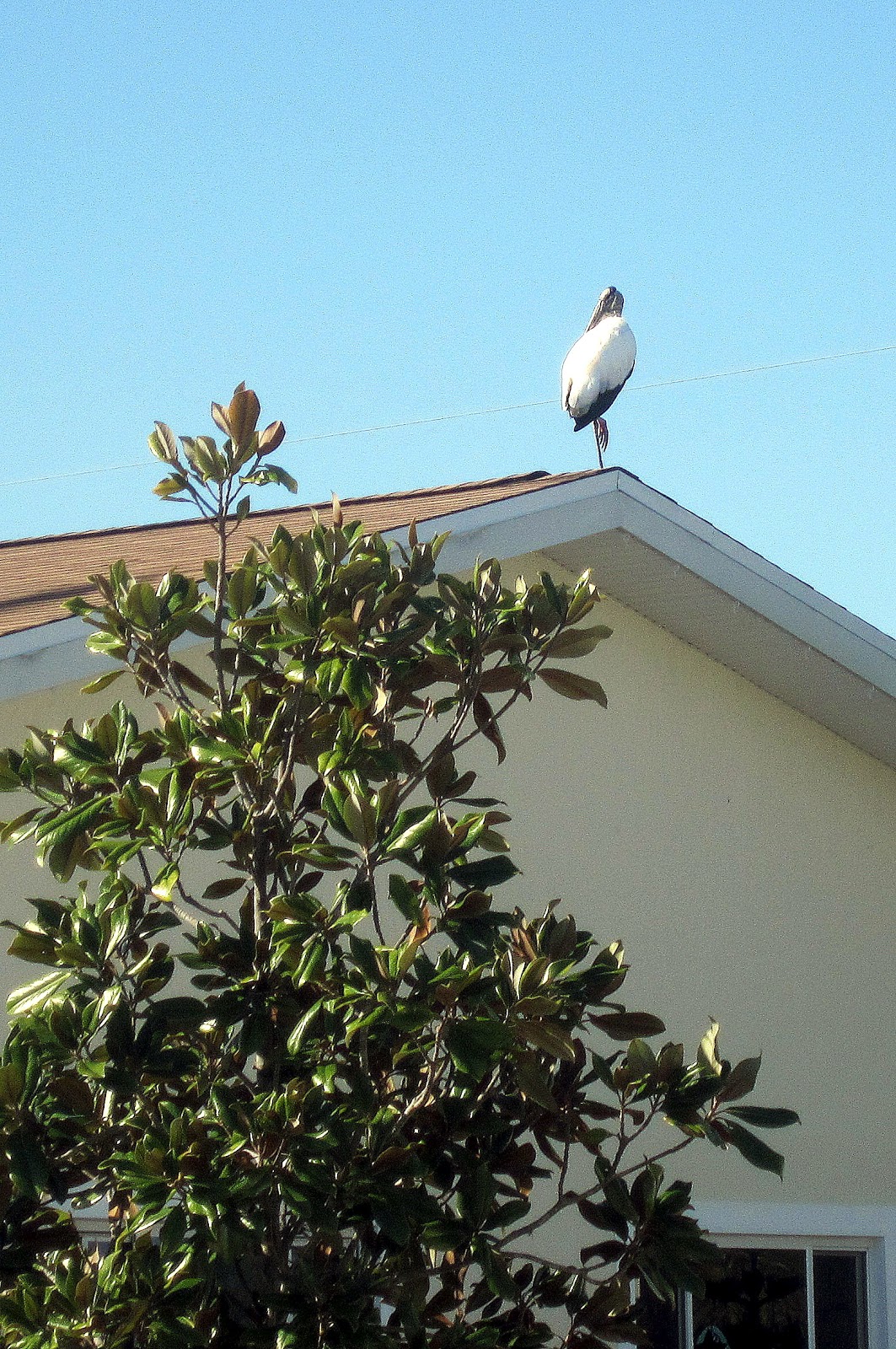 |
| I wonder if there is a new baby here |
 |
| Former Waffle House |
We were headed to our favorite Waffle House. Yes, I admit it...I am hooked on their waffles. We drove up the highway way past where we usually see the big yellow Waffle House sign. Then we went back down the same road and there it was...closed and all signs of yellow on the building and sign were gone.
We settled for the IHOP across the street but it was less than satisfactory. I won't rant here but we will not be back there.
 |
| A Bromeliad |
 |
| Begonias |
 |
| Sand Hill Cranes |
 |
| See the little flower bud? |
 |
| Another angle |
Then today I saw the first flower stalk!!! I will be taking photos as soon as a flower opens...you bet!!! I have three pots with about 8 plants. The individual plants are hard to count when they start multiplying. I will have to do more research as to what species they are and remember the long names.
 Labels:

Another Item Checked Off

I didn't get my new Canon Rebel XTi until the next day but I didn't think this photo was too shabby for a little Canon PowerShot ELPH.
FROM WIKIPEDIA:
Armadillos are small placental mammals, known for having a leathery armor shell. The Dasypodidae are the only surviving family in the order Cingulata, part of the superorder Xenarthra along with the anteaters and sloths. The word armadillo is Spanish for "little armored one".
There are approximately 10 extant genera and around 20 extant species of armadillo, some of which are distinguished by the number of bands on their armor. Their average length is about 75 centimeters (30 in), including tail; the Giant Armadillo grows up to 1.5 m (5 ft) and weighs 59 kg (130 lbs), while the Pink Fairy Armadillos are diminutive species with an overall length of 12–15 cm (4–5 in). All species are native to the Americas, where they inhabit a variety of environments.
In the United States, the sole resident armadillo is the Nine-banded Armadillo (Dasypus novemcinctus), which is most common in the central southernmost states, particularly Texas. Their range is as far east as South Carolina and Florida and as far north as Nebraska; they have been consistently expanding their range over the last century due to a lack of natural predators and have been found as far north as Illinois and Indiana.
Habitat and anatomy
Armadillos are prolific diggers. Many species use their sharp claws to dig for food, such as grubs, and to dig dens. The Nine-banded Armadillo prefers to build burrows in moist soil near the creeks, streams, and arroyos around which it lives and feeds. The diet of different armadillo species varies, but consists mainly of insects, grubs, and other invertebrates. Some species, however, are almost entirely formicivorous (feeding mainly on ants).[citation needed]
Armadillos have poor vision. The armor is formed by plates of dermal bone covered in relatively small, overlapping epidermal scales called "scutes", composed of bone with a covering of horn. In most species, there are rigid shields over the shoulders and hips, with a number of bands separated by flexible skin covering the back and flanks. Additional armor covers the top of the head, the upper parts of the limbs, and the tail. The underside of the animal is never armored, and is simply covered with soft skin and fur.[1]
This armor-like skin appears to be the main defense of many armadillos, although most escape predators by fleeing (often into thorny patches, from which their armor protects them) or digging to safety. Only the South American three-banded armadillos (Tolypeutes) rely heavily on their armor for protection. When threatened by a predator, Tolypeutes species frequently roll up into a ball. Other armadillo species cannot roll up because they have too many plates. The North American Nine-banded Armadillo tends to jump straight in the air when surprised, and consequently often collides with the undercarriage or fenders of passing vehicles.[2]
Armadillos have short legs but can move quite quickly, and have the ability to remain underwater for as long as six minutes. Because of the density of its armor, an armadillo will sink in water unless it inflates its stomach and intestines with air, which often doubles its size and allows it to swim across narrow bodies of water.[3]
Armadillos use their claws for digging and finding food, as well as for making their homes in burrows. They dig their burrows with their claws, only making a single corridor where they fit themselves. They have five clawed toes on the hindfeet, and three to five toes with heavy digging claws on the forefeet. Armadillos have a large number of cheek teeth, which are not divided into premolars and molars, but usually have incisors or canines.
Gestation lasts anywhere from 60 to 120 days, depending on species, although the nine-banded armadillo also exhibits delayed implantation, so that the young are not typically born for eight months after mating. Most members of the genus Dasypus give birth to four homozygous young (that is, identical quadruplets), but other species may have typical litter sizes that range from one to eight. The young are born with soft leathery skin, which hardens within a few weeks, and reach sexual maturity in 3-12 months, depending on the species. Armadillos are solitary animals, that do not share their burrows with other adults.[1]
Sunset by the Lake


Winding Down
We visited friends yesterday about 2 hours South of us. I was amazed by the differences in wildlife. Their Anoles are so much larger than ours. One seemed about the size of a small chipmunk. I love our little guys; Lizzies, my granddaughter calls them.

We also saw big Iguanas just sitting alongside the road, and in culverts. The ones we saw were dark, not the bright green of the one that took up residence in the wreckage of our shed in 2004 after the hurricanes. The Animal Shelter assured me that an iguana that big and that color would not be living this far North in the wild, but must have been someone's pet that escaped in the storm. The fact that he ran to me for protection when the Shelter man tried to catch him made us think he may have belonged to a woman, and probably lived in her screen room, many of which wound up at the bottom of our lake. That night the temps went into the 40s and the shelter said the Iguana would have been stressed, and maybe even died from the cold. I didn't feel so bad about calling them. They assured me he would find good home if they couldn't reunite him with the original owner. (I will post a photo of him here when I get back North where the old photos are.)
The parrots South of us were another surprise. Several times we saw small flocks of 10 or so flying from tree to tree. Once in the tree, however, they camouflaged so well I couldn't find one to take a photo of it. They strike me as exotic as much as the Peacocks running wild an hour North of us. Looks like I still have a lot more pictures to try and get next year.
All along the turnpike, as we headed home, there were Armadillos at their evening feeding. There was no way I could snap pictures of them from the moving car and the traffic was too heavy to pull over. Some day. Those strange animals have fascinated me since my grandmother used to have an Armadillo "shell" for a bizarre fruit basket in the middle of her dining room table back North.